
DSPN exists to support and be a resource for member providers through advocacy and education resources so they can provide the highest quality and full array of services for those with disabilities throughout Wisconsin
DVR Updates
The Joint Committee on Finance approved the Department of Workforce Development's Division of Vocational Rehabilitation (DVR)'s 13.10 funding request, yesterday, June 2nd. The approval provides DVR with General Purpose Revenue in the amount of $600,000 in State Fiscal Year (SFY) 2026, and $6,400,000 in SFY 2027. Read the full news release here.
What's Next
DVR will begin activating individuals from the waitlist with a goal to eliminate the waitlist by June 30, 2027. DVR will first serve all individuals in Category 1, those with the most significant needs, on the waitlist. Then DVR will serve all individuals in Category 2, those with significant needs, and finally all other individuals in Category 3, until all individuals on the waitlist are served and new eligible individuals are not placed on a waitlist.
What it Means to You
While JFC did not fund the entire 13.10 request, individuals are finally being transitioned off the waitlist. Whether you directly provide DVR services or support those that utilize these supports, we hope that you'll agree that this reflects progress on our collective advocacy priorities. DSPN truly appreciates everyone that took time to engage with their legislators on this critical issue. There's more work ahead and we're invested in your success.
Have questions? We are here to help! support@dspn.org
DSPN remains in regular communication with the Division of Vocational Rehabilitation (DVR) to discuss matters affecting your programs and clients. Thank you to all that have shared your experiences and observations.
2026-2028 DVR Technical Specifications, Fee Schedule, & Initial Resources Now Available
Effective Date: July 1, 2026
The Division of Vocational Rehabilitation (DVR) has published updated Technical Specifications, Fee Schedule, and select initial implementation resources for the 2026-2028 cycle. These updates will take effect July 1, 2026.
The updated materials reflect DVR's biennial review process and were developed with input from DVR staff and Service Providers, including workgroups and surveys. Updates focused primarily on improving clarity, consistency, usability, accessibility, and alignment across services and reports/forms.
2026-2028 Reports/Forms
-
The 2026-2028 Reports/Forms will be published on July 1, 2026, and will then replace prior versions on the DVR website.
-
Service Providers should use the updated Reports/Forms for service delivered on or after July 1, 2026.
-
For services started before July 1, 2026, Service Providers may use the previous 2024-2026 Reports/Forms.
Service Transition Guidance
-
Services authorized prior to July 1, 2026, should continue following the 2024-2026 Technical Specifications.
-
Services authorized on or after July 1, 2026, must follow the 2026-2028 Technical Specifications.
-
As a reminder, per fiscal policy, invoices must be submitted within 60 days of the end of service.
Additional Resources & Website Updates Coming Soon
In addition to the updated Technical Specifications and Fee Schedule, DVR is also:
-
Updating and reorganizing the Service Provider webpage
-
Adding and revising FAQs and implementation guidance resources
-
Developing additional support materials and resources related to the 2026-2028 updates
Select newly developed resources and tools are now available in addition to the 2026-2028 Technical Specifications and Fee Schedule. Additional supporting materials (including report completion guides, updated training modules, FAQs, and other reference resources) will be released in phases following this initial publication. These resources will be added to the Technical Specifications webpage as they become available.
Resources
-
2026-2028 Technical Specifications Updates Presentation Materials (April 2026)
-
2026-2028 Technical Specifications Updates Recording (April 2026)
-
-
How to Submit Reports to DVR (updated; formerly Scanning Methods)
DVR is introducing new Service Provider Qualification Requirements (SPQR).
DSPN is actively collecting provider feedback on these requirements to ensure that your voice is heard. We will keep you informed as this process develops.
Updated SPQR FAQs Now Available (04/21/2026)
The Division of Vocational Rehabilitation (DVR) has updated the Service Provider Qualification Requirements (SPQR) Frequently Asked Questions (FAQs) to reflect common questions and feedback received during recent provider engagement, including the SPQR Informational Q&A session.
These updates are intended to provide additional clarity and support providers as they prepare for implementation.
Key updates include:
-
Clarification on which staff are required to meet SPQR.
-
Additional detail on qualification pathways, including use of prior training.
-
Recognition of certain master’s-level degrees as meeting qualification requirements.
-
Confirmation that the Wisconsin APSE Employment Services 40-hour training is accepted as meeting SPQR requirements.
-
Information on IPS Employment Center trainings and how they apply.
-
Expanded guidance on Alternative Training Plans, including use of existing training, combining trainings, and structured training expectations.
-
Additional information on implementation, reporting, and compliance monitoring.
DVR will continue to update the FAQs over time as additional questions are received and addressed.
We encourage providers to review the updated FAQs here: SPQR FAQ webpage
DVR will also provide a brief SPQR update during the upcoming Statewide Service Provider meeting on April 28, which will focus primarily on Technical Specification updates.
If you have additional questions or need support, please contact: DVRServiceProviders@dwd.wisconsin.gov
What You Need to Know
Service Providers delivering certain DVR statewide services must meet qualification requirements through one of three pathways:
-
ACRE-approved training
-
Active CESP certification
-
DVR-approved Alternative Training Plan
ACRE-approved training and an active CESP certification automatically satisfy the qualification requirements, regardless of when they were completed. Training (internal or external) outside of these pathways, regardless of when completed, must be submitted through the Alternative Training Plan process and approved prior to counting toward qualification requirements.
These qualification requirements apply to the following statewide services:
-
Customized Employment (CE)
-
Internship/Temporary Work (I/TW)
-
Job & Task Analysis and Systematic Instruction (JTA & SI)
-
Job Preparation, Development, Hire, and Retention (JP, JD, Hire, & Ret)
-
Student Work-Based Learning (SWBL)
-
Supported Employment (SE)
Timeline:
-
Existing staff must meet the requirements by July 1, 2027.
-
New hires (after July 1, 2027) will have 9 months from their hire date to meet the requirements.
Ongoing Professional Development:
-
DVR is not requiring formal continuing education at this time. Service Providers are encouraged to support ongoing professional development to maintain and enhance staff skills.
Where to Find More Information
All SPQR resources are now available on the DVR website, including:
Visit the Service Provider Qualification Requirements webpage to review requirements, access documents, and find guidance for your staff.
2026-2028 DVR Service Agreement
A recorded presentation of the 2026-2028 DVR Service Agreement and other agreement renewal resources are available at 2026-2028 Service Agreement Resources: Online Account Updates.
The recording includes an overview of the 2026-2028 Agreement and the process for entering into the new Agreement.
The 2026-2028 DVR Service Agreement is available at DVR Statewide Service Provider Agreement.
If you are interested in entering into the 2026-2028 Agreement, the following will apply:
-
March 9-April 15, 2026:Complete Agreement prerequisites and DVR Service Provider Portal updates (Please see: DVR Service Provider Agreement Renewal Timeline & Agreement Prerequisites).
DEADLINE: Agreement Prerequisites and Portal Updates must be completed by April 15, 2026. Please contact the DVR Contract Specialist, David Knuth at david.knuth@dwd.wisconsin.gov or 608-405-4634 if you have any questions
Should you have additional questions or concerns, please let us know: support@dspn.org

DVR Order of Selection
DVR leadership will be hosting a virtual Order of Selection (OOS) update meeting for Service Providers on June 18, 2026, from 11:00 a.m. to 12:00 p.m.
A calendar invitation with meeting details will also be sent out to provider main contacts following this communication.
Questions may be directed to DVRServiceProviders@dwd.wisconsin.gov
DSPN remains in regular communication with the Division of Vocational Rehabilitation (DVR) to discuss pressing matters affecting your programs and clients. Thank you to all that have shared your experiences and observations.
DVR has filed a 13.10 request with the Joint Finance Committee (JFC).
You can view DVR's communication with JFC here.
Should you have additional questions or concerns, please let us know: support@dspn.org
What Can You Do
Contact the members of the Legislature's Joint Committee on Finance, and your state Senator and state Representative. Tell them that this situation contradicts the legislature's intention to support competitive integrated employment for people with disabilities and hinders Wisconsin employers' ability to recruit and retain skilled employees with disabilities.
Access DSPN's Position Paper - 13.10 DVR Funding Request
Members of the Legislature's Joint Committee on Finance and their contact information can be found here. DSPN also developed list of Order of Selection Talking Points to help with your advocacy efforts.
Please contact us at support@dspn.org if you have questions!
Background
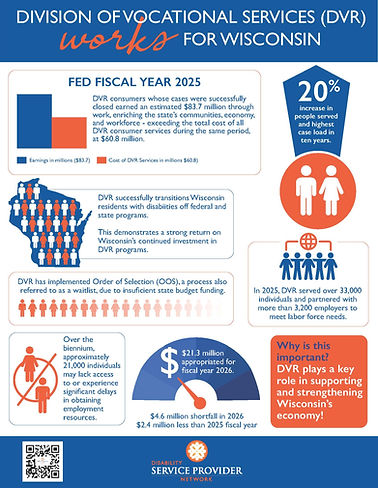
Wisconsin’s Division of Vocational Rehabilitation (DVR) recently announced the implementation of an Order of Selection, which essentially creates a waitlist for accessing its services due to insufficient funding.
Why is this important? DVR plays a key role in supporting and strengthening Wisconsin’s economy.
DVR receives 78.7% of its funding from the U.S. Department of Education, which requires a 21.3% match from the State of Wisconsin's General-Purpose Revenues.
Governor Evers proposed sufficient funding in his executive budget for the 2025-27 biennium to ensure that all job seekers with disabilities have access to vocational rehabilitation services through DVR. However, the Joint Finance Committee opted for a lower funding amount than the governor proposed, despite the Legislative Fiscal Bureau indicating that this decision could require additional funding to provide vocational rehabilitation services to all Wisconsinites in need of support.
The final state budget appropriated $21.3 million in state funds for the fiscal year 2026. This amount is $2.4 million less than what was spent in fiscal year 2025 and falls $4.6 million short of the projected need for this year.
Over the past four years, there has been a 20% increase in the number of individuals served by DVR, leading to the highest caseload in a decade. In 2025, DVR served more than 33,000 people and collaborated with over 3,200 employers to address labor force needs.
In federal fiscal year 2025, DVR consumers whose cases were successfully closed earned an estimated $83.7 million through work, enriching the state's communities, economy, and workforce. This amount exceeded the total cost of all DVR consumer services including staff wages – during the same period, at $60.8 million. This outcome demonstrates a strong return on Wisconsin's continued investment in DVR programs.
DVR successfully transitions Wisconsin residents with disabilities off federal and state programs such as Supplemental Security Income (SSI) or Social Security Disability Income (SSDI).
A waitlist would immediately impact approximately 2,000 individuals (consumers) with an additional 1,000 consumers affected each month until sufficient funding is allocated. Over the biennium, approximately 21,000 individuals may lack access to or experience significant delays in obtaining employment resources.